
Federal judge rejects Trump DOJ’s bid to unseal grand jury materials in Ghislaine Maxwell case
Entities mentioned:
- Judge Paul Engelmayer: Justice, Duty, Professional pride
- Trump administration: Control, Influence, Self-preservation
- Department of Justice: Transparency, Duty, Influence
- Ghislaine Maxwell: Self-preservation, Control, Greed
- Jeffrey Epstein: Power, Control, Greed
- Victims: Justice, Self-respect, Security
- Attorney General Pam Bondi: Duty, Loyalty, Influence
- Judge Richard Berman: Justice, Duty, Professional pride
Article Assessment:
Credibility Score: 75/100
Bias Rating: 45/100 (Center)
Sentiment Score: 35/100
Authoritarianism Risk: 25/100 (Generally Democratic)
Bias Analysis:
The article presents a balanced view of the situation, quoting extensively from the judge's ruling. While it mentions the Trump administration's involvement, it doesn't appear to take a partisan stance.
Key metric: Public Trust in Government Institutions
As a social scientist, I analyze that this article highlights a significant tension between the judiciary and the executive branch, specifically the Department of Justice under the Trump administration. The judge's scathing rejection of the DOJ's request to unseal grand jury materials in the Maxwell case reveals a deep skepticism of the government's motives. This conflict could potentially erode public trust in government institutions, particularly the DOJ. The judge's emphasis on the lack of new information in the requested materials and the suggestion that the government's motion might be aimed at 'diversion' rather than transparency raises questions about the administration's true intentions. Furthermore, the mention of victims being used for 'political warfare' underscores the complex interplay between justice, politics, and media attention in high-profile cases. This incident may contribute to a growing perception of government institutions being used for political purposes rather than serving justice, potentially leading to decreased public confidence in the justice system and federal agencies.
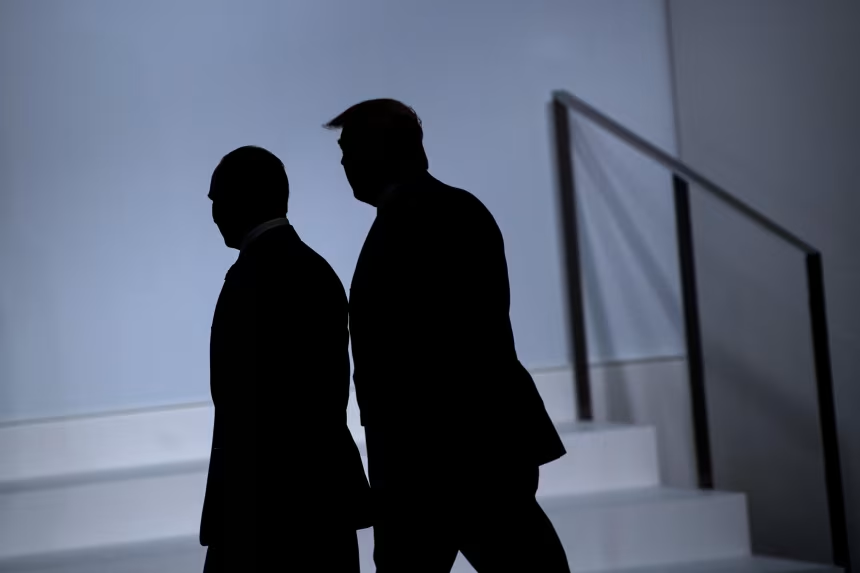
Trump says he’ll be feeling out Putin as US officials rush to finalize details of Alaska summit
Entities mentioned:
- Donald Trump: Ambition, Legacy, Power
- Vladimir Putin: Power, Control, Influence
- Volodymyr Zelensky: Self-preservation, Justice, Determination
- Mark Rutte: Unity, Duty, Security
- Oksana Markarova: Duty, Loyalty, Unity
- Steve Witkoff: Duty, Influence, Ambition
- JD Vance: Duty, Influence, Ambition
- Lindsey Graham: Influence, Loyalty, Duty
- Friedrich Merz: Unity, Influence, Security
Article Assessment:
Credibility Score: 75/100
Bias Rating: 45/100 (Center)
Sentiment Score: 35/100
Authoritarianism Risk: 35/100 (Generally Democratic)
Bias Analysis:
The article presents multiple viewpoints and sources, including Trump, European leaders, and Ukrainian officials. While it leans slightly towards skepticism of Trump's approach, it generally maintains a balanced tone, providing context and varied perspectives.
Key metric: International Diplomacy Effectiveness
As a social scientist, I analyze that this article highlights the complex dynamics of international diplomacy surrounding the Russia-Ukraine conflict. Trump's approach to the summit with Putin demonstrates a high-stakes gamble in personal diplomacy, potentially bypassing traditional diplomatic channels. The exclusion of Zelensky from direct talks raises concerns about Ukraine's agency in its own future. European leaders' insistence on Ukraine's involvement and specific conditions for peace talks indicates a potential rift between US and European approaches. The rush to organize the summit and the lack of clear objectives suggest a potentially risky diplomatic strategy. The article also reveals the delicate balance of power and influence among world leaders, with each actor motivated by a mix of national interests, personal legacy, and geopolitical considerations.